• Home
  • About Me
  • Contact Me
  • Books
    • Devotion Distribution Watch
    • Children’s Lit
  • Web Design and Content Writing
  • Rejected Orphans
    • A Ruff Murder

Anna Denisch

~ Renaissance Woman

Anna Denisch

Monthly Archives: March 2020

Block Scheduling: It’s Not Just for Dentists

31 Tuesday Mar 2020

Posted by amdenisch in Uncategorized

≈ Leave a comment

Tags

add, personal

A bit of history on the title, first:

My mom is the business manager for a dentist. Nearly a year ago they set up a system to help them maximize profits. They had their schedule set up in blocks. The early morning was reserved for easy, non-drill procedures, the afternoons for new patients and high-cost production. This alleviated full days full on low-cost appointments. It was a system that helped them make more money, and it’s a system I put in place to help with both my writing and everyday life.

Block scheduling. 

If you’ve been following along since day one (or went back and read the first blog post of mine), you’ll know by now that I have ADD. And even though the medicine makes life exponentially better, there’s still some issues. I have a lot of habits I picked up to deal with/give-into the problem that I now need extra work on to fix. 

What that means is I’m really bad at doing things and now there’s no excuse. 

I still have a tendency towards laziness because my unmedicated brain needed it and now I’m just used to it. Whereas before it was a necessity, now it’s a choice. And it’s one that I’m working on every day to change. And block scheduling has really helped.

The wonderful thing about block scheduling is that it’s super easy to customize and personalize to fit your lifestyle, needs, and activities. Science tells us that the ‘average brain’ (as if there’s such a thing) can only focus for two hour intervals before it needs a break. (Someone ought to let schools in on this knowledge). But each person is unique, and so your ‘focus’ time may be different. You could last as long as three hours or as little as ten minutes. But that’s what’s great about block scheduling. You get to create the sizes of the blocks.

Let me show you what mine currently looks like:

Morning:
-Up between 8-8:30
-Breakfast and phone games (I have a lot). Done by 9
-Clean up or work until 10
-Hyperfixation time til 11
-Clean up or work until 12

Afternoon:
-Take medicine around 12 or 1
-Hyperfixate until hungry/1
-Lunch and phone games. Done by 2
-Clean up or work until 4
-Hyperfixate until hungry/7
-Whatever the heck until bed around 10/11 (It takes me a solid hour to fall asleep)

Do you see how much wiggle room I even gave myself? That’s the other joy of block scheduling. There’s always room for that last-minute emergency patient that just has to be seen at 10, or that 45-minute drill procedure that ended up taking an hour. The walls of your blocks aren’t stiff and straight. They’re flexible. They’re more like rolls of clay you can smoosh about day by day as you need. 

Here’s the thing I’ve noticed about schedules. You either love ‘em or you hate ‘em. 

I hate ‘em.

I can’t tell you why, but the very concept of a ‘routine’ makes me want to die. Doing the same thing every day for all of eternity is torture. And that hasn’t changed with the medication, I’m pretty sure that’s just a part of my personality. 

But this is…routine without routine. That’s a thing. By creating blocks for myself that I can stretch and smoosh as I please, I’m making space for getting things done, while also allowing the freedom to do what I want as the fancy strikes me. 

From 9-10 I have to clean or work. But I can choose what I want to do. One day I might do the dishes and clean the counters. The next I might work on some writing. Maybe I’ll apply to more freelance jobs (I am for hire. Call me). Or maybe, like today, I’ll start on a blog post because it’s been a while since the last one and I’ll be so into it that it’s now 10:38 and I’m still working. 

Block scheduling is mainly there to get me to do something on days when I want to do nothing. I even consider proper human socialization as work (of course, with our current need for social distancing) so I might spend that hour skyping with a friend or talking with my roommate. Anything that accentuates my well-being or gets my work done belongs in those squares. And I’m free to mix and match as I please. 

Of course, if you’re one of those people that loves schedule and routines (who may be an alien I’m still figuring that out), then you can make this schedule as tight and rigid as you’d like. You might have it set up so that from 9-10 you write, and nothing else. You might even go so far as to break that block into smaller blocks and say from 9-9:30 you work on one project and from 9:30-10 you work on the other. Or you might just say from 9-11 you’ll write and just work on whatever the inspiration is for that day. 

It doesn’t matter. There’s no wrong way to do a block schedule. 

Okay. That’s not completely true because there is a sort of…hypocriticalness that falls into the schedule. But I promise you it’s one that’s actually good for you.

For those of you who don’t know, people with ADD and its variants have these things called hyperfixations. Others get them too, but with the brain of chaos, it’s a lot more intense, and can actually last months if not years. Having one of these is torture. Because literally all your brain can focus on is that thing. It can be a show, a game, a book, your cat, a new friend. Doesn’t matter. What does matter is that’s all your brain wants and doing anything not related to that is akin to being tortured for information, only you don’t actually know what it is they want to know. 

I don’t recommend it. 

As I said before, medication has helped a lot. But there’s still that intense need and desire that pops up when something new and good shows up that makes my brain do the ahhhh and makes doing anything else really hard. Not impossible, but difficult. 

So, the point. 

In my schedule you’ll see I’ve carved out time for my current hyperfixation. If you’re between fixations right now, or simply don’t get them, you might fill this in with whatever free time/relaxation activity you enjoy, be it reading, sewing, or making chairs from toothpicks. Whatever it may be. 

I use my hyperfixation (currently Animal Crossing, big surprise, I know) to get my work done. I essentially hold it hostage. This is where the ‘doing it wrong’ part can occur. 

If I take, as I am now, an hour of my fixation time to finish work, I haven’t really done anything wrong. All work and no play may make Jack a dull boy, but stopping the workflow you’ve got going on to play makes you a little crazy and is not conducive to a good work-ethic. 

However, let’s say your current fixation is a T.V. show. It’s got those hour long episodes that are really 45 minutes long. It’s 10. You start an episode. It’s now 10:50 (maybe you took a pee or snack break). The episode is over. You have 10 minutes until you’re supposed to be cleaning or working. You think ‘it’s okay. I can just start the first bit of the episode. I’ll totally stop at 10.’

Next thing you know it’s midnight and you’ve done nothing all day. A great deal of this requires you actually stopping the thing you want to do to do the thing you need to do. A lot easier, for me, with medication, but still hard. 

Another way you might break the system is by not doing the thing you want to do until it’s time, but not doing anything else. I haven’t really been super productive one day if I sat around doing nothing from 9-10 just waiting until I’m allowed to play. I only get to play/rest if I’ve actually done something. 

Of course, flexibility is still a factor. 

As example: I painted some of my kitchen cabinets the other day. As you can imagine, my muscles were pretty much dead for a while. (Still kind of are). This means my work and clean times were considerably shorter and less intense, because I was recovering. 

The thing about block scheduling is changing it up as you need to fit what’s going on. It provides enough structure and routine to help you get things done, but it allows for enough change that you don’t feel bogged down by certain tasks or stuck in a rut. And you can even have different schedules for different days (particularly useful for if you’re in college). 

But I’m not going to lie and pretend like this isn’t easier for me to pull off because I have no kids and work from home even when there’s not a mandate to do so. But it can still work, for everyone.

If you do have kids, a lot of your schedule is going to revolve around their own. But fret not! There’s still time in the day for relaxing. In fact, there’s lots of ways to unwind and relax with your kids. Play a board game with them, watch a movie together. Read to them. If they’re older maybe they can share an island with you in Animal Crossing. If they don’t need any help with their homework, take that half-hour (in an ideal world right?) off and put your feet up for a bit. 

And this schedule can help with work too. (I assume, anyway, I haven’t been able to actually try it out). With most jobs you have a list of things you need to do, either projects to complete or daily tasks to repeat. Schedule them out. If you have to re-fold shirts, take note of the time and do it every hour. Schedule in your own mini-breaks to get some water or go for a quick walk. The work day is, unfortunately, not conducive to actually getting work done. But you can still take control and set up blocks for yourself to keep focused and productive. 

I’ve been at this schedule for about three weeks now, and it’s worked. I haven’t gotten a lot of writing done, but that’s for an entirely different reason. I’ve been keeping up on cleaning, painting cabinets, and getting in the hyperfixation fix! 

So give it a try. Flex and mold as you see fit. You may be surprised by how un-routine your new routine feels!
Living in the Subjective World, or: How to Deal with Rejection

11 Wednesday Mar 2020

Posted by amdenisch in Uncategorized

≈ Leave a comment

Tags

authors, query, ramblings, writing

Today I participated in Pitmad on Twitter. By the time I publish this post, it’ll be long over, but it really got me thinking about something. One of the struggles with being a writer and going the traditional publishing route is that the whole business is subjective. 

Now, let me preface this by getting a little depressive. 

A long time ago, nearly two years, I had my first manuscript finished. It was cleaned, edited, it had passed and gave me my M.F.A. I took it to a conference I was going to with my friend. We only went to this conference specifically because they were holding agent and editor meetings, where you had five minutes to pitch and talk about your book to up to 3 agents or editors. 

I struck out with the first two cause my book didn’t feature a lot of romance (and of the agents and editors in attendance, about 90% were romance people). But the third one got interesting. The third one hit me with that ‘go ahead and send the full manuscript over, this sounds really interesting’. 


And for those of you not in the business or who are just starting out, that’s a pretty big deal. Rarely does a meeting like this end with a full manuscript request. I remember rushing out of the room and immediately going to my laptop and sending it off. 

After the eons of waiting it takes for anything to happen in this industry, I got the reply. You can probably tell it wasn’t going to be a good one. But it was worse than that. It was a fill-in-the-blank, enter-name-here kind of rejection. I figured, hey, if they wanted the whole manuscript, they might have had something to say about it. 

But no.

Was I going to let that stop me? 

Okay, maybe briefly, but I got back up again.

(Insert long interlude featuring a not-to-be-named agent who ghosted me)

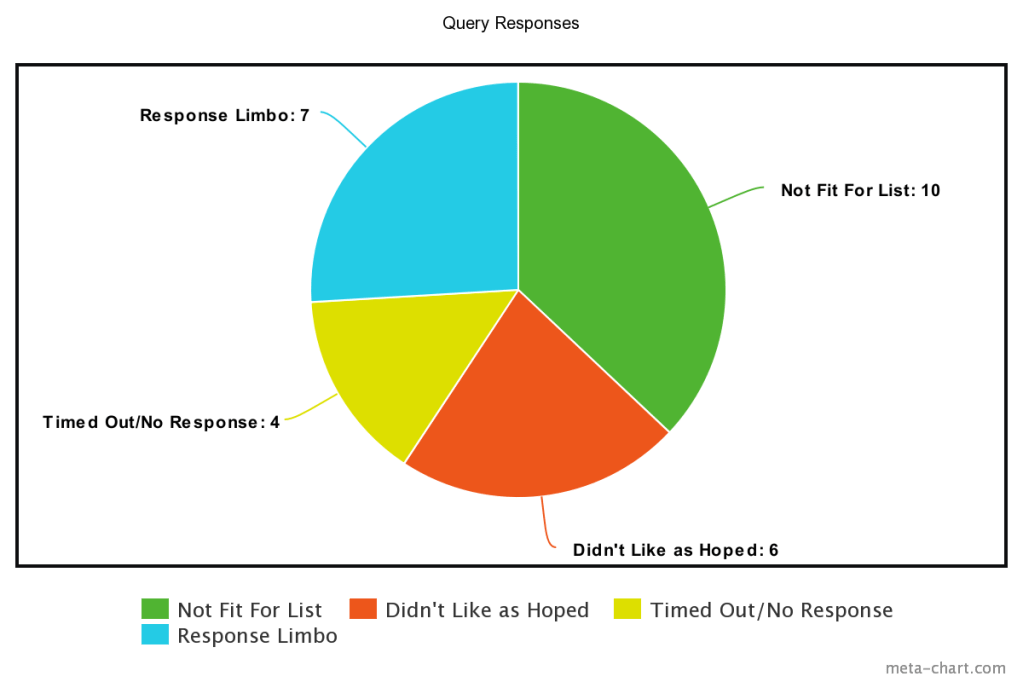
For the last four or so months, I’ve been sending this book and two others out to anyone who would even remotely be interested in their genres/concepts. I’m going to make a chart of the responses so far. It’s fun, trust me.

That’s a total of 27 queries. Well, there were 28, actually. But this one response was so unique it couldn’t possibly fit into any other category. (As it turns out, it is possible to start a story too close to the start).

For a little clarification, Response limbo are queries that I haven’t heard back from that either didn’t have a ‘if you don’t hear from us by’ date, or just haven’t reached it yet. 

I highly encourage everyone to keep a record of the response times and reasons for rejections. On the one hand, it gives you something to do while you’re waiting/working on the next manuscript. It also provides amazing insight. 

For example, I have gotten six responses that were along the lines of: I didn’t connect/like this story as I had hopped. Which got me down to thinking that I’ve maybe got a good idea for something here but my writing is just terrible.

(That’s a fun rabbit hole to go down, I don’t suggest it).

But this chart here shows that that kind of response isn’t even a full quarter of the responses! (22.22% for those wondering). 

Now I’m not going to go on a rant about how I don’t think it should be all that hard to send a simple rejection back. (I’ll save that for later). But I do want to get back on track, finally, and look at those 10, Not Fit for List responses.

THE PUBLISHING WORLD IS SUBJECTIVE. AND THAT’S REALLY TERRIBLE.

Okay, got that out of my system. 

What do I mean by the publishing world is subjective? Well, it should come as no surprise to fellow veterans of the pitch wars that agents and editors both feel the need to fall in love with a book. Which is totally valid. 

They need to love the book so they can get the urgency to promote and sell it. You want them to love your book. You need them to love your book so they’ll do all they can to get it out into the hands of other people who will love your book. (And pay you for it, of course).

So yeah, it makes sense that an agent is going to look at your query, think, “okay this is kind of interesting I see where they’re going with this, but, eh, not my cup of tea.”

This doesn’t mean they don’t think your book can sell. This doesn’t mean they don’t see an audience for it. It just means that they aren’t the audience for it. Which is why:

IT’S REALLY TERRIBLE.

Alright, I lied. I had more yelling in me.

The thing is, there’s this connection in your brain that starts to happen as you get rejections over and over again. You think your writing isn’t good. You think your idea is crap. You think there’s no one out there in the world who will ever read your book because agents and editors are supposed to know the market and if no one is taking your book than clearly there’s no market. 

Listen, our brains aren’t stupid. They may be dumb but they’re usually logical. And with all the stuff you hear from everywhere about agents and what not, it’s easy to see how they got to this conclusion. (I wrote it down in the paragraph above in case you missed it).

So that leaves us with a precarious problem. What do you do when you keep getting rejected and you want to scream and/or give up?

Here’s what!

Get a grip, first of all. Start keeping that log of the amount of time a response took and why it was rejected. Go through old emails and query tracker responses to check. Make a chart or graph. Study it. Learn from it. Discover your common response. (And make note of the fun, unique ones).

You’ll probably see that a certain response or type of response isn’t as big a deal as you thought. 

Secondly, remember this phrase. Don’t worry, I won’t shout it this time.

The publishing world is subjective and that’s really terrible.

Say it to yourself. Make it a mantra if that’s your jam. Write it on a post-it and stick it on your monitor. 

Third: Do some math. Pick a popular book. The book you hold in your hands at night weeping over because you’ll ‘never be that great’ and you wished you had written it instead. I’m going to use Harry Potter because, well, it’s Harry Potter.

Some quick, possibly factual google searches later…

The last major milestone that the series, as a whole, hit was 500 million copies in 2018. Keep in mind, that’s over a 20 year span, covering 7 books, and includes the rise of fame via a movie deal.

Let’s math it up. Not every book sold the same amount, but for simplicity’s sake, let’s say they did. That rounds down to 71 million copies sold per book. 

Sounds like a lot huh. That’s a lot of people who have read that book, huh?

But really, lets look at the bigger picture. There’s 7. whatever billion people living in the world. But you’re right, you’re right. Not all of them read, and not all of them can afford books. So let’s say, for this example, that we’re only going to look at people in the developed world and we’re going to pretend they’re all adults capable of reading. 

If you believe everything I read on the internet, there’s about 1.16 billion people who fit that bill.

More math. Isn’t it fun.

Divide the 1.16 billion people who live in this section of our world by the copies of books sold. Yes, I know some books were probably shared among people and we can’t account for library reads, but who said math had to be precise?

It’s 16. 

So, theoretically, the audience for Harry Potter is 1 out of every 16 people. And that’s for a cultural phenomena with a movie deal and 20 years backing it. 

I’ve sent out 28 queries. If I was querying Harry Potter as it’s known now, I’d still have only, theoretically, gotten 1 response. (And that’s 28 spread out among three books, keep in mind.) 

Do you see what I’m getting at here?

For every person that does own a singular Harry Potter book, there’s 15 that don’t. 

So do the math. Find out your favorite books percentage. See how big their audience actually is. Realize that yours is going to be smaller, especially at the start. 

(This can also be accomplished by trying to find out how many times your favorite book was rejected. Harry Potter’s was 12, which is only four off our statistical estimate. It also means my most queried book is only one away from the magic number).

The last, and final step.

Now that you’re tired from all the math, do some research. On self-published authors.

And I don’t mean get discouraged and go look up how to do it yourself. I mean go find them and read their blogs or tweets. Heck, you can even try to reach out to them for an interview. Find out why they self-published. Discover what kinds of rejections they got. Realize that they’re selling copies like hotcakes because, and here’s the kicker: there’s a market for everyone and everything. 

Yes, even your book with it’s X number of rejections. Yes, even my book with its interesting concept but terrible execution. (I may still be stuck in the rabbit hole. Toss down a rope, would ya?)

The point of this constant rambling is: don’t lose hope. Keep up the good fight. You just gotta find the one agent that is part of your audience, and then you’ll get to watch it spread. (Or be your own audience and self-publish and inflict your greatness upon the world. Either way works).

Devotion
out now!
Buy Here

Tweets by AnnaDenisch

Find me on Facebook

Find me on Facebook

Recent Posts

  • The Books Aren’t Better, They’re Bigger
  • 2023 SavvyAuthors Workshop Lineup
  • Receiving Constructive Criticism
  • Giving Constructive Criticism
  • New Article and Workshop!

Recent Comments

Dilranga Perera's avatarDilranga Perera on Giving Constructive Criticism

Archives

  • January 2023
  • September 2021
  • August 2020
  • June 2020
  • March 2020
  • February 2020
  • January 2020

Categories

  • Reader Musings
  • Uncategorized
  • Writer Workshops
  • Writing Musings

Meta

  • Create account
  • Log in
  • Entries feed
  • Comments feed
  • WordPress.com

Navigation

  • A Ruff Murder
  • About Me
  • Books
    • Devotion Distribution Watch
  • Children’s Lit
  • Contact Me
  • Newsletter
  • Rejected Orphans
  • Web Design and Content Writing
Click here to show form

Recent Comments

Dilranga Perera's avatarDilranga Perera on Giving Constructive Criticism

Create a free website or blog at WordPress.com.

Privacy & Cookies: This site uses cookies. By continuing to use this website, you agree to their use.
To find out more, including how to control cookies, see here: Cookie Policy
  • Subscribe Subscribed
    • Anna Denisch
    • Already have a WordPress.com account? Log in now.
    • Anna Denisch
    • Subscribe Subscribed
    • Sign up
    • Log in
    • Report this content
    • View site in Reader
    • Manage subscriptions
    • Collapse this bar
 

Loading Comments...